Menorca, often called the "little sister of Mallorca", is both the easternmost and northernmost island of the Balearic Islands. 95,000 inhabitants live on the 700 square kilometre island - about one tenth of the population of Mallorca.
Read more after the ad
Read more after the ad
The neighbouring island is also many times larger at 3,600 square kilometres. But the name basically says it all: Menorca in Catalan means something like the smaller one. And size is never the decisive factor anyway.
Camí de Cavalls is the way of the horses
A completely different number is much more important: 185. That is how many kilometres the Camí de Cavalls measures, the Way of the Horses, which has probably become the most important hiking trail on the island. It leads once around Menorca, always along the coast, and reveals the diversity of the landscape as, at best, the view from above during the approach to the airport.
Read more after the ad
Recommended editorial content
At this point you will find external content from Qualtrics Ireland Limited that complements the article. You can view it with one click.
I agree to external content being displayed to me. This may transmit personal data to third party platforms. Read more about this in our privacy policy.
Here, the fine little beaches where many bask in the sun from the morning, some as they are - which, among Menorcans, does not always include a bathing suit. There, the wetlands of the S'Albufera Natural Park, a reserve for fish and birds. And finally, the vast grey of the slate cape Favàritx and the coasts with their cliffs dropping steeply into the Mediterranean.

One of Menorca's most famous lighthouses: Favàritx with its striking spiral painting on the black slate rocks.
© Source: Michael Pohl
Hiking trail leads along the coast
The Camí de Cavalls offers a bit of everything. It was originally built centuries ago to provide access to the coast. Later, it was mainly used by the military to defend the island in case of emergency. In the 20th century, wealthy landowners discovered the view and developed properties directly on the path.
It was not until the 1980s that the Menorcans completely reclaimed their circular path. Much to the delight of visitors, who since then prefer to walk it in stages.
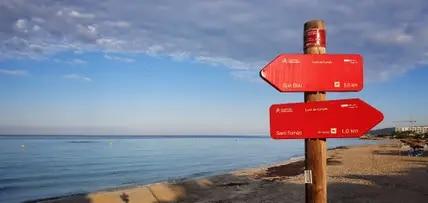
Always follow the red signs: The Camí de Cavalls leads once around Menorca.
© Source: Michael Pohl
Read more after the ad
Read more after the ad
Pigeon cave considered Menorca's natural cathedral
We take a detour: from the village of Es Migjorn in the south of the kidney-shaped island, we head back through nature towards the Camí de Cavalls. While the sun is blazing in many places, a wooded area provides shade here in summer temperatures. But above all, a stopover is cooling: the Cova des Coloms, the pigeon cave, in the Binigaus gorge.
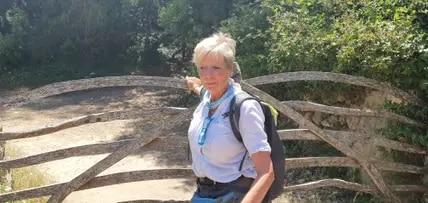
Tour guide Jutta Vaupel knows all the corners of "her" island, having lived on Menorca for 31 years.
© Source: Michael Pohl
Tour guide Jutta Vaupel, a native of Westphalia in Germany, calls it the "natural cathedral of Menorca", and anyone who enters the 24-metre-high, 110-metre-long cave will know why. The natural spectacle is impressive; you freeze when you see it, as if you were in a cathedral, simply because of its enormous dimensions. In the past, the cave was used as a cowshed and sheep pen, Vaupel says. Now it is protected as a cultural asset and a destination for nature lovers.
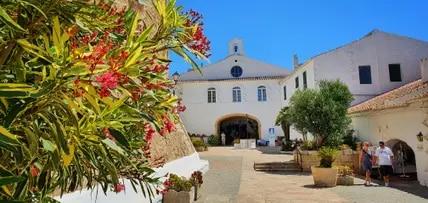
Monte Toro, the island's highest peak at 342 metres, not only offers a panoramic view, it is also home to the Verge del Toro monastery.
© Source: Michael Pohl
Playa de Sant Tomàs is one of the longest beaches on the island.
The path leads back to the sun: at Sant Tomàs, the route ends at a well-known spot - the Camí de Cavalls, in the middle of the sea. Playa de Sant Tomàs is one of the longest beaches in Menorca. A popular seaside resort with several hotels, bars and restaurants has developed along it. Here another difference to other Spanish islands becomes clear: the height of the hotels. "We have very few tall buildings here," says Jutta Vaupel, and the view of the artificially created place confirms this: Three-, four-storey buildings are the tallest. The sea is almost always visible.
Read more after the ad
Read more after the ad
Magnificent villas in the capital Mahon
An impression that is later consolidated in the capital: Mahon is known beyond the island's borders as the place where mayonnaise ("mahonnaise") is said to have originated. But above all, it is the pulsating centre of the island. The houses rise steeply from the harbour, and some tell the story of the former trading centre.
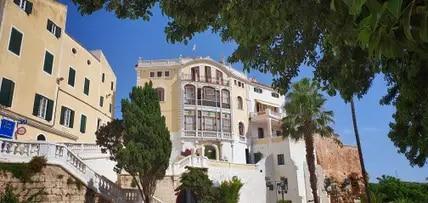
Legacies of a long trading history: old villas in Menorca's capital Mahon.
© Source: Michael Pohl
Splendid villas of former entrepreneurs stand there, the fish market, which today has become a small market hall with snack stands, also an old electricity plant. And not far away, opposite the big ships, there is a small business rich in tradition: the Xoriguer distillery.
Read more after the ad
Read more after the ad
Gin according to a historic recipe
After the British conquered the island in 1708, the stationed soldiers missed a drink from their homeland in the following years: gin. A few craftsmen from Mahon had the solution. They imported juniper berries, which did not grow on the island, and used them together with wine alcohol to produce what is probably the first gin on the Balearic Islands.
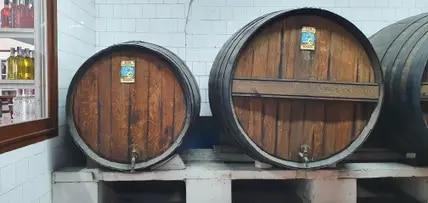
What the British liked is now also enjoyed by tourists: Mahon's gin distillery Xoriguer.
© Source: Michael Pohl
"To this day, the berries come to us from the Pyrenees," says Maria Luis Torrent of the family business Gin Xoriguer. In the meantime, 2,900 litres of gin are produced daily according to a historical recipe in the copper kettles, some of which are 280 years old - most of it for export all over the world. On Menorca, says Torrent, they drink it differently than in the rest of the world: not with tonic, but with homemade lemonade. Pomada is what the Menorcans call it, and as with the gin recipe itself, they don't want to change it.
Club Cova d'en Xoroi is a hip address
In the evening it becomes clear: elsewhere the island is already changing cautiously - and, strictly speaking, setting new standards. Cova d'en Xoroi is the name of a club in the south of the island in Cala en Porter. Not just any club, as you know them from the neighbouring islands. The coastal village was one of the first on Menorca to be opened up for tourism. It has developed accordingly in the meantime.
Read more after the ad
Read more after the ad
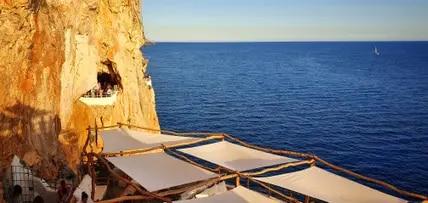
Where Menorca does Ibiza: Club Cova d'en Xoroi is housed in a cave on the cliffs of Cala en Porter.
© Source: Michael Pohl
Ibiza feeling on Menorca
The Cova d'en Xoroi is a club housed in the caves of the town's cliffs, and probably the best place to gaze at the sunset over the Mediterranean. Club music blares from the light-flooded caves, inside mostly young people drink their pomada or cocktail and practise taking selfies in front of the sea. Outside, a queue of people patiently waits to be admitted.
Menorca may often be compared to Majorca, but in Cala en Porter, it can also be compared to another Balearic island in a very likeable way: Ibiza, the party island. Just like there, everyone is bound to be in a good mood in the Cova d'en Xoroi.
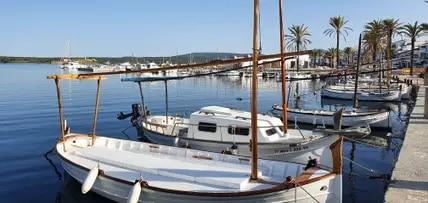
Those who don't want to hike will find variety in small coastal towns like Fornells in the north of Menorca.
© Source: Michael Pohl
Island is a Unesco Biosphere Reserve
We're on the coast, and it's clear: not far away runs an already well-loved acquaintance, the Camí de Cavalls. The hiking trail is waiting for us again the next day, because after all, one comes to Menorca primarily for the nature. Since 1993, the island has belonged to Unesco's 700 biosphere reserves. "Two-thirds of the area is protected in terms of landscape," explains Menorca expert Jutta Vaupel. In retrospect, the island benefits from the fact that it was once neglected, especially under the Franco regime: Tourism started here later than on Mallorca and Ibiza, says Vaupel. And that's probably why they were able to learn from the mistakes of others.
Read more after the ad
Read more after the ad
Bronze Age settlement to become cultural heritage site
Another big step in tourism development is on the horizon: Because of its prehistoric finds such as Torralba d'en Salord, a Bronze Age settlement, Menorca applied to Unesco years ago for World Heritage status. There are more than 1500 such sites on the island, grouped together for Unesco under the title "Talayotic Culture of Menorca".
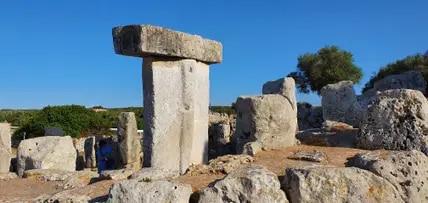
Among the sights on the island of Menorca are the numerous prehistoric finds such as the Torralba d'en Salord.
© Source: Michael Pohl
Nothing has been decided yet, but the chances are good according to the Menorcans. And Vaupel is also hoping for a signal soon - so that her island gets the attention it deserves. Or, as she puts it, "We think it's coming."
Tips for your trip to Menorca
Arrival: By plane, for example, directly from Frankfurt am Main, Berlin, Düsseldorf, Hamburg or Hanover - but sometimes only a few times a week. Also possible: by plane via Mallorca, where there are connecting flights to Menorca almost all day. Also nice: a ferry trip between the two islands, which is offered several times a day in the high season (duration: around 1.5 hours).
Read more after the ad
Read more after the ad
Best time to visit: Travelling is possible all year round, although it can get hot in summer and rain more often in winter. Spring and autumn are the best times for hiking.
Camí de Cavalls: The Camí de Cavalls hiking trail circles Menorca for a total of 185 kilometres. Many areas offer neither refreshment stops nor hotels, so for a relaxed trip you should walk it in stages and stock up on water beforehand.
www.camidecavalls.com
Walking tours: Wikinger Reisen, among others, offers numerous tours on Menorca. For example, a 15-day hiking group tour with German-speaking tour guide on the Camí de Cavalls from 1895 euros (including flights, accommodation in double rooms, half board).
The trip was supported by Wikinger Reisen, Turespaña and the Menorca Tourist Board. The editorial team alone decides on the selection and orientation of the content.