Off the Spanish coast lie paradises of lush nature, lapped by the crystal-clear waters of the Mediterranean Sea. The Balearic archipelago comprises four main islands plus several smaller islets.
Each of the four islands has its own identity. Mallorca, the largest, boasts beautiful beaches and villages steeped in history, hidden in a spectacular mountainous landscape. Menorca is an oasis of peace and tranquillity that preserves unspoilt beaches and prehistoric monuments. Ibiza is the queen of partying and the haunt of party animals from all over the world. Formentera, chic and exclusive, enchants with its white beaches and refined elegance.
What are the Balearic Islands?
Majorca
Menorca
Ibiza
Formentera
Cabrera
Conejera
Dragonera
Es Vedrà
Espalmador
Espardell
Tagomago
What to choose and what to see
Ancient ports of call for Phoenician merchants, the Balearic Islands over the centuries were conquered by the Romans, Vandals, Byzantines, Arabs, the Republic of Pisa and the Aragonese. Today, they form an autonomous community of Spain that has elected Palma de Mallorca as its capital and Catalan as its official language.
The small Spanish archipelago attracts thousands of visitors every year, but despite this it has managed to maintain its integrity. The Balearic Islands are Mediterranean pearls that captivate with their fabulous beaches and social life. But if you get away from the more touristy and crowded centres, you will discover Gothic cathedrals, Neolithic megaliths, fishing villages and beautiful paths through sand dunes, olive groves and orange groves. Here is what to see in the Balearic Islands.
Majorca
It is the largest island of the Balearic Islands (3640 square kilometres) and has been welcoming an increasing number of visitors since the 1950s. It is an island with a varied landscape that offers much more than wonderful sunny beaches. Palma de Mallorca is the capital of the island and of the entire archipelago.
It is a pretty city with tree-lined boulevards and cobbled streets, Gothic churches by the sea such as the cathedral of Santa Maria, also known as La Seu, and Baroque palaces such as the Palma City Hall. Next to the cathedral, don't miss the Almudaina Palace, in Gothic style but with Arab influences: it is the residence of the Spanish royal family when they are in Mallorca. Palma is also a very lively city by day and by night. 3 km from the capital is the castle of Bellver, or del Belvedere in Italian, built in 1311 in Gothic style by King Jaime II of Mallorca. It is one of the few circular castles in Europe and today houses the Palma City History Museum.
To the north-west of the island is an area rich in olive groves, pine forests and charming villages, characterised by a rugged coastline and dominated by the mountains of the Serra de Tramuntana, a Unesco World Heritage Site. Numerous footpaths will let you explore this spectacular mountain range with 54 peaks over 1,000 metres high, including the highest in Mallorca and the Balearic Islands, Puig Mayor (1,436 metres). The Formentor lighthouse, located at the end of the Formentor cape, is geographically the most northerly point in the whole of Majorca. Here, the landscape is spectacular: steep cliffs overlooking the sea, lush Mediterranean vegetation and unforgettable sunsets. On Mallorca's north-east coast, then, don't miss Alcudia, an interesting town where you can spend a day between the old town centre, the beautiful beach and the seafront restaurants.
Last but not least, Mallorca has beautiful beaches located mostly on the north and east coasts. Most of these have been overrun by tourist facilities but you can still find unspoilt coves.
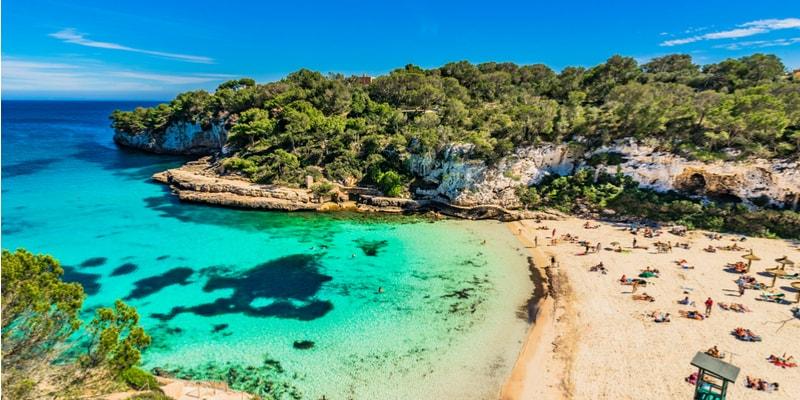
Some of the most beautiful are Son Moll, the beach in the village of Cala Ratjada, Mgaluf, the beach of unbridled fun, playa Formentor, an oasis of peace, Es Trenc, a tongue of sand surrounded by vegetation and lapped by turquoise waters, and playa de El Arenal, a very long free beach behind which are hotels, restaurants and nightclubs. Smaller but very beautiful are Illetas, Cala Bona and Cala Millor.
Finally, among the most bizarre places on the island, you can see the Cuevas del Drach, cave of the dragon, in the municipality of Manacor, near the village of Porto Cristo. It is a set of four connected caves that extend to a depth of 25 metres underground, around a large underground lake, where classical music concerts are held. Ladies, on the other hand, will want to visit the legendary Manacor pearl factory.
Menorca
Menorca is the quietest and least touristy of the Balearic Islands. Part of the credit, according to some, goes to General Francisco Franco. When neighbouring Majorca came under the control of the Nationalists at the beginning of the Civil War, Menorca resisted with all its might. Later, Franco rewarded Majorca by not imposing any rules on building growth and penalised Minorca by hindering its development. However, the second largest and northernmost of the Balearic Islands, it is the archipelago's green paradise that captivates travellers with its pristine beaches, crystal-clear sea, fishing villages and lush nature.
Maó is the island's capital, where the English influence can still be strongly felt after almost 100 years of rule. The town sits atop the cliffs protecting the southern side of the harbour, and still retains a few old buildings, but you will be amazed by the many palaces in the sober 18th century Georgian style.
Ciutadella, on the other hand, founded by the Carthaginians, destroyed by a Turkish invasion and rebuilt in the 17th century, was the capital of Menorca until the arrival of the British. Unlike Maó, Ciutadella, referred to as 'vella i bella', old and beautiful, is a picturesque town with a charming old centre and a pretty harbour.
A few kilometres south of Maó stands Fort Marlborough, an old fortress built between 1720 and 1726 by the British to protect the town harbour. The rugged and rocky northern coast of Menorca hides some of the most beautiful and little-visited beaches in the Balearic Islands. Here, in the north-east, is also the Parc Natural de s'Albufera des Grau, a 5100 hectare salt lagoon that is the island's main wetland. The reserve is criss-crossed by three hiking trails to discover the wilderness and its inhabitants, including the Balearic lizard. Also along the north coast, don't miss Fornells, a picturesque village of whitewashed houses that sits on a wide bay frequented by windsurfers. The southern coast of Menorca, on the other hand, boasts the most beautiful beaches on the island and is therefore the most touristic area. The rugged coastline is interrupted by small sandy beaches surrounded by more and more white Moorish-Mediterranean houses. Don't miss Binibeca Vell, a small fishing village where you can wander through the maze of narrow streets and whitewashed houses.
The interior of Menorca, on the other hand, offers a dip into prehistory. In the heart of the island you can visit important sites dating back to 2000 BC. These include the Talayotic village of Talatí de Dalt around Maó, to the south of Alaior the village of Torre d'en Gaumès and to the east of Ciutadella the Naveta des Tudons.
But the real reason to go to Menorca are its beaches.
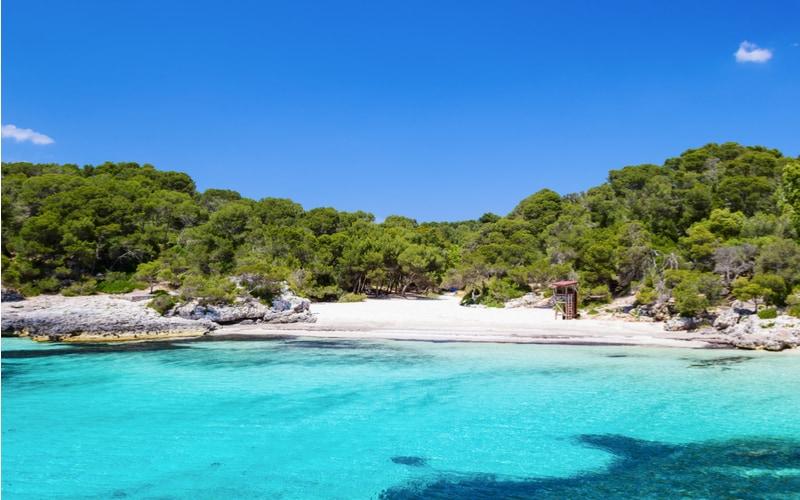
There are plenty of them, including many coves that fill up quickly in summer. Among the best we recommend Cala Galdana, a 500-metre-long, crescent-shaped beach on the south coast of Menorca, Cala en Turqueta, which takes its name from the Tudon waters, Cala Mitjana, one of the most famous in Menorca, and its smaller sister Cala Mitjaneta. But remember that many of the most beautiful beaches are free, you will find neither shade nor services of any kind, so get organised.
Finally, Menorca is certainly not the most party-loving of the Balearic Islands but it does boast several bars and clubs including Cova d'en Xoroi, the original and atmospheric club carved out of a natural cave overlooking the sea.
Ibiza
Ibiza, or Eivissa, is internationally recognised as the nightlife island par excellence. It is an extreme island, both in terms of its landscape and the type of tourism it attracts. In the 1960s, Ibiza began to attract visitors for its beautiful beaches and quiet atmosphere. It became a destination for European hippies in search of a secluded place to connect with the universe. Today the island has 143,000 residents, but in summer it welcomes thousands of sun-seeking visitors, including new hippies, nudists, jet setters and party animals. Ibiza town is the island's capital, located in a natural harbour on the south-eastern coast. The city boasts a charming old town surrounded by ancient walls, the Dalt Vila, a Unesco World Heritage Site, perched atop a hill overlooking the entire area. Also not to be missed are the Marina and Sa Penya neighbourhoods, a maze of narrow streets packed with boutiques, bars and restaurants with whitewashed facades.
The wide Passeig de Vara de Rey, on the other hand, is a favourite street for a sunset stroll. Ibiza town is also one of the hubs of nightlife, with hotels, restaurants and legendary clubs such as Pacha. But Ibiza is all about partying. The most famous clubs, scattered all over the island, are Privilege, Amnesia, Es Paradis, Eden, El Divino, DC10 and Space. If you want to have a detailed calendar of all the scheduled parties, have a look at the Ibiza Spotlight website. Be aware, however, that the fun in Ibiza is not cheap, entry to most clubs is between 50 and 60 euros, but around the island you will be given leaflets with discounts.
Moving away from the hustle and bustle of the entertainment centres, you will discover the natural beauty of another Ibiza. Like Formentera, Ibiza was in fact called the 'island of pines' by the Greeks, because it was largely covered by dense pine forests, but also olive, fig and almond trees. Especially in the northern part of the island and inland, you will see beautiful landscapes that embrace coastal hills and mountains to be discovered on foot or by bicycle. Portinatx is the main tourist centre on the north coast with three beautiful beaches. Inland, Sant Miquel de Balansat is worth a visit, where you will find a 14th-century square-shaped church in whose patio traditional dance performances are held. The east coast of Ibiza is criss-crossed by a scenic road that passes by Cala Llonga, a beautiful bay with high rocky cliffs.
Here visit Sana Eulària d'es Riu, Ibiza's third largest town and a quiet resort with a few beaches and a large harbour.
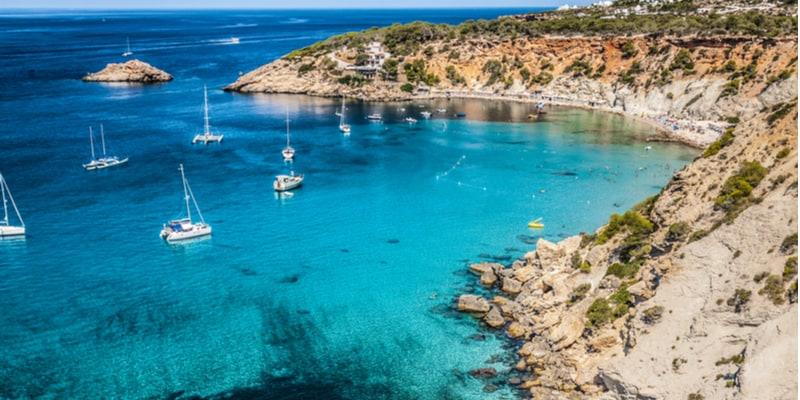
On the west coast is Sant Antoni de Portmany, an ancient town that dates back to prehistoric times and is now better known for its tacky appearance and kitschy clubs. If you are in the area, don't miss the sunset at Café del Mar to the sound of its renowned lounge music. Finally, head south for the most beautiful but also busiest beaches on the island. Here you will find Platja de ses Salines, a wide sandy beach frequented by party crowds, Platja d'es Cavallet, Ibiza's official naturist beach, the famous Playa d'en Bossa, Sa Caleta with its red cliffs, and the enchanting Cala d'Hort with its renowned restaurants. But Ibiza has about 80 beaches, so explore the others as well. On the west coast are Cala Comte, Cala Bassa, Cala Salada, Cala Tarida and Cala Vadella. On the east coast Cala Llenya and Cala Llonga. The wild northern coastline, on the other hand, boasts smaller beaches such as Cala Benirras, also known as Hippy Bay, Cala Xarraca, Aigües Blanques, Es Figueral and Cala des Multons. Find your favourite.
Formentera
It is the smallest and least built-up of the archipelago, but also the most glamorous and exclusive. Formentera enchants with its white sandy beaches and turquoise waters, unspoilt nature and salt pans glistening in the sun. The island has no airport and can be reached from Ibiza by a quick ferry crossing. For this reason, Formentera is popular with day-trippers or tourists, mostly Italians, who want to experience this idyllic island by spending a few nights in one of the island's fine and expensive hotels. Formentera measures less than 20 km in length from east to west and is mostly flat, rugged and in some areas barren.
The main town is Sant Francesc Xavier, a charming village of whitewashed houses where you can see the 14th-century chapel, the 18th-century fortress and the Museu Etnològic.
To the south of Sant Francesc Xavier is Cala Saona, one of the most beautiful beaches on the island where there is a luxury hotel and a couple of bar-restaurants. Follow the narrow road to the south to reach Cap de Barbaria, the southern tip of the island dominated by a solitary white lighthouse. On the northern coast, on the other hand, lies Es Pujols, once a quiet fishing village later overrun by tourism. Here you will find beautiful but very crowded beaches, but you will find more isolated ones walking towards Platja de Llevant. At the eastern end of the island is Es Caló, a fishing village situated on a tiny rocky cove where you will still see wooden shelters for boats. Continuing further east, you arrive at the village of Es Pilar de la Mola, where the market is held, and then at Far de sa Mola, a monument dedicated to Jules Verne, who set one of his novels here. Those fascinated by the underground world can then visit the Coves d'en Xeroni, a series of caves east of Sant Ferran.
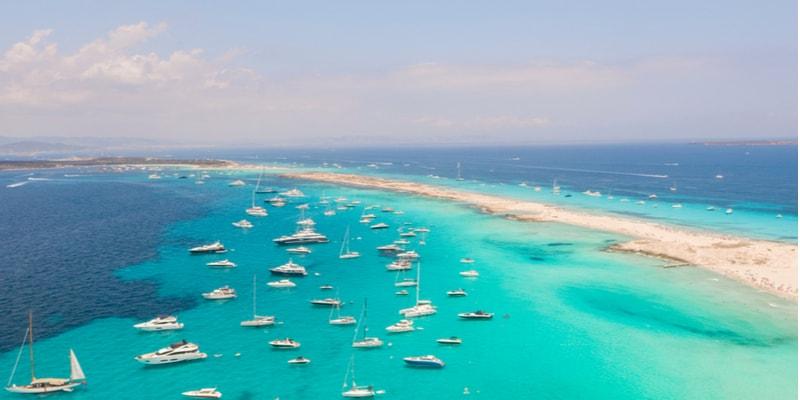
Finally, relax on Formentera's beautiful beaches. Platja de Llevant and Playa ses Illetes are the most beautiful and famous on the island. They are wonderful stretches of white sand lapped by crystal-clear waters reminiscent of the Caribbean, located respectively on the eastern and western sides of the narrow promontory stretching north towards Ibiza. You will find yourself on a long tongue of sand, surrounded by the sea on both sides. Es Pujols boasts another beautiful sandy beach, accessible via wooden walkways that serve to protect the dunes.
Es Pujols is also the starting point of a 4-kilometre-long hiking trail that leads to La Savina at the tip of the promontory, where a narrow arm of the sea leads to Illa s'Espalmador, a deserted islet with beautiful beaches and thermal mud. Cala Saona then impresses with its colours and the horseshoe shape of the bay. Along the southern coast is the Platja de Migjorn and at the eastern end the beach of Es Arenals.
From the four main islands you can also reach the smaller Balearic islands in a day trip. These include Cabrera, Conejera, Dragonera, Es Vedrà, Espalmador, Espardell and Tagomago.
Most beautiful beaches in the Balearics
Cala d'Hort, Ibiza
Cala Pilar, Menorca
Calò des Mort, Formentera
Cala Blanca, Majorca
Platjia des Bot, Menorca
Cala Mitjaneta, Menorca
Cala Xarraca, Ibiza
Cala n Turqueta, Menorca
Cala s'Almonia, Mallorca
Cala Bassa, Ibiza
What to eat in the Balearic Islands
Balearic cuisine is rich in fish, vegetables and island fruits. Among the specialities to be sampled are caldereta de langosta, a lobster soup typical of Menorca, brut rice (rice cooked with vegetables and legumes), grilled pork, lamb roasted over a wood fire, and the fish salad of Formentera, the frito Mallorquín (a typical Majorcan dish of fried meat cooked in blood), the cocarrois (breaded meat, fish or vegetables), and the borrida de rajada (a typical dish from Ibiza made with skate, potatoes and eggs). For those who like to combine sea and mountains, porcella amb anfós is a mixture of pork and grouper meat, seasoned with chilli and garlic. Then try the coques, a kind of sweet or savoury flatbread.
Among the desserts, don't miss the gató de almendras (almond cake) and the ensaimada, the symbol of Mallorca, whose name derives from saïm (pork fat), which is the base of the dough of this cake. But also greixonera de brossat (fresh cheese cake), cuscussó (Christmas cake of Arab origin), flaó (cheese and mint herb cake), panellets and orelletes (sugar and dried fruit pastries). To drink, Mallorca's wines are renowned, with two DOCs, that of the municipality of Binissalem and that of Pla de Llevant. Liqueurs include ginebra, palo, an aperitif made from caramelised sugar and herbs, and frigola.
Getting to and around the Balearic Islands
Majorca, Menorca and Ibiza each have their own airport, so you can reach them with one of the many direct flights from Italy. Once there, however, it is worth renting a car or motorbike to be able to explore the island freely. Formentera has no airport and can be reached by ferry from Ibiza.
When to go to the Balearic Islands
The Balearic Islands enjoy a Mediterranean climate, with mild winters and warm, sunny summers, sometimes sultry but tempered by breezes. In fact, the islands are quite windy, especially in the period from October to April. So the ideal period for those seeking a beach holiday is clearly summer. In terms of events, each island celebrates traditional festivities such as the Festa de Sant Joan in Menorca with processions, horse parades, music and dance performances in the third and last week of June. As throughout Spain, Semana Santa is held and Carnival is celebrated.
In addition, there are several music festivals such as the Mallorca Live Festival held in May. The whole summer, however, is one continuous party in the Balearic Islands.
Spain