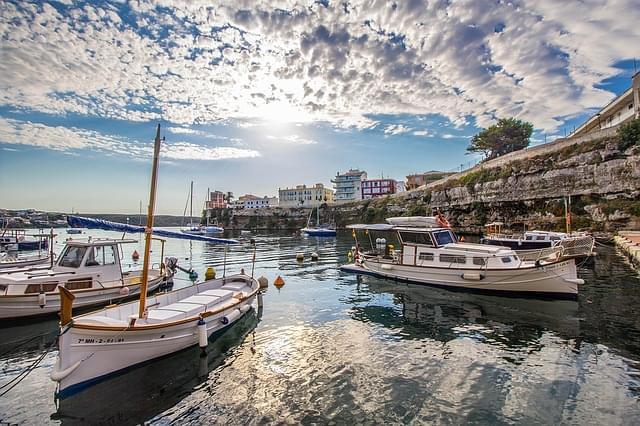
 The second largest island in the Balearic Islands, Menorca is the place to be if you are looking for a holiday of relaxation, silence and calm. Surrounded by turquoise-coloured waters, with more than 80 beaches and coves, some of which are still unspoilt, Menorca is certainly the most charming Balearic island, and far from mass tourism. But, natural beauty is not the only highlight of the island, which can also rely on other features, such as good cuisine, historical beauty and the charm of the stately architecture of its main towns.
Travel information: useful info
Inhabitants: 86 697
Main centre: Mahon
Languages: Catalan and Castilian
Local currency: euro
Climate: Mediterranean, with mild, relatively wet winters and warm, sunny summers. The average temperature ranges from 11 °C in January and February to 25 °C in August.
Vaccinations: no vaccinations required
Entry requirements: Italian and EU citizens do not need to apply for an entry visa, just carry a valid ID card or passport.
Distance from Italy: 856.42 km (1-2 hour flight)
Location
Menorca is an island of Spain, the second largest of the Balearic archipelago, and is located in the Mediterranean Sea to the east of Mallorca.
How to get there
By plane: the international airport is located 5 kilometres from Mahon. From Italy there are some direct one-hour flights in summer. At other times of the year a flight with stopover in Barcelona is compulsory. Compare flights
By Sea: Menorca is connected by sea to Barcelona (4 hours by boat) and the other Balearic Islands.
When to go? Info on climate and best time
Month | Average temperatures (min/max) | Precipitation (days/mm) |
|---|---|---|
January | 8 / 14° | 7 days / 60 mm |
February | 8 / 14° | 6 days / 50 mm |
March | 8 / 16° | 7 days / 50 mm |
April | 10 / 17° | 7 days / 45 mm |
May | 13 / 21° | 5 days / 30 mm |
June | 17 / 25° | 2 days / 15 mm |
July | 20 / 28° | 1 day / 5 mm |
August | 21 / 29° | 2 days / 25 mm |
September | 19 / 26° | 5 days / 60 mm |
October | 15 / 22° | 8 days / 100 mm |
November | 11 / 18° | 8 days / 85 mm |
December | 9 / 15° | 8 days / 80 mm |
Climate: Mediterranean, with mild, relatively wet winters and warm, sunny summers. Winter is from December to February, and is characterised by mild temperatures, with sunny days but also periods of rain and wind. It is never very cold, although temperatures can drop to 10°, and days can be windy. Summer, from June to mid-September, is hot and sunny, with rare thunderstorms. Muggy heat waves cannot be excluded in July and August, with highs of 35/38 degrees.
Best period: for beach life, the period from June to mid-September is ideal. April and May are suitable for excursions, given the mild climate. The cheapest and most enjoyable months are May and September.
Period to avoid: generally in the winter season
Advice: Menorca is a windy island, so it is good to carry a scarf in any season. Summer clothes in natural fibres, hat for the sun, sun cream, comfortable shoes for excursions, snorkelling equipment. In winter, summer clothes, sweatshirt for the evening, umbrella for precipitation, comfortable shoes for hiking.
10 things to see: beaches and places of interest
Albufera des Grau Natural Park: a vast natural lagoon comprising five islets. The park contains two wetlands, long stretches of unspoilt beach, the islet of d'en Colom and several farms, where traditional agriculture is practised
Mahon: the city most visited by tourists due to its proximity to the island's only airport, Mahon is located in the south of the island and is built around the largest natural harbour in the entire Mediterranean. Quiet during the day and lively at night, the town has many cultural attractions, including a colonial-style historic centre, museums, shops and more.
Monte Toro: Menorca's highest point, located halfway between Ciutacella and Mahon, is home to the Santuario de la Virgen del Toro, an ancient Augustan monastery, the religious heart of the island and a pilgrimage destination
Es Mercadal: a small town located at the foot of Monte del Toro, it is considered by many to be an obligatory stop for those who want to discover the history of Minorca. Built according to the criteria of traditional popular architecture during the 13th century, the town is perfect for nature lovers, walking and cycling.
Fornells: a typical fishing village, overlooking one of the most beautiful bays on the north coast of Menorca. What attracts tourists to this area is not only the natural beauty of the place, but also the possibility of practising water sports and the particular houses in the village, all built in white lime.
Ciutadella: Minorca's second most important city and the centre of the summer nightlife, Ciutadella is a must-visit place for those who want to spend their holiday steeped in culture, history, but also a lot of fun. Situated in the north of the island, Ciutadella has earned a reputation as a town with two souls: an ancient one, made up of Baroque and Gothic buildings, and a more modern one
Es Castell: a town with a military character, famous for its museum inaugurated on the occasion of the bicentennial of the conquest of Minorca by Spain. Es Castell is also famous for its markets, which wind through the streets of the centre every Monday, where you can admire the works of master craftsmen. Of course, there is no shortage of nightclubs and various forms of tourist entertainment.
Alaior: Located between Mahon and Ciutadella, Alaior is the third most important town on the island, where history and modernity blend perfectly. Although landlocked, the town still benefits from a beach, Son Bou, where the remains of the Palaeo-Christian Basilica, the prehistoric settlement Torre d'en Galmés and Ses Roques Llises, the oldest megalithic construction on the island, are located.
Binibeca Vell: a tourist complex recreated on the features of a Mediterranean fishing village. A pretty village, made up of white houses, narrow alleys, small bars and a lot of silence, overlooking a small harbour.
Binebeca Beach: rocky and characteristically U-shaped, the beach has one of the most beautiful sandy bottoms for snorkelling and diving. The fact that you have to walk along a narrow impervious road to reach it means that the area is little frequented by tourists and locals alike.
What to do in Menorca: excursions and tours
How much does a holiday in Menorca cost? Prices, offers and advice
 Average accommodation prices range from €32.00 for a hostel, to €54.00, for a 1-star hotel: the period you decide to stay also makes a difference. As for meals, on the other hand, two people in a middle-class restaurant for a three-course menu costs around €30.00: the price drops to €10.00 in an inexpensive restaurant. An Italian driving licence is valid on the island, and renting a car can cost between €15.00 and €21.00. The cost can go up further depending on the characteristics of the car and the period.
Where to stay: Hotels and B&Bs from €35.00 per room - see offers
Low cost flights: from €95.00 - look at the offers