Astrotourism puts the spotlight on the sky, on knowing how to look beyond the clouds to discover the stars. An art in which the Canary Islands are at their best: the starry skies here are a spectacle that has no equal. The combination of shimmering sea, volcanic landscape and sky dotted with lights creates postcard scenes that are hard to forget. Like nature, the skies here are also protected by the Law on the Protection of the Astronomical Quality of Observatories. The belvederes on the islands that draw a varied and well-stocked map of interesting destinations have earned awards and certifications. A sign that, in all of Europe, a place so close to the celestial mantle does not exist.
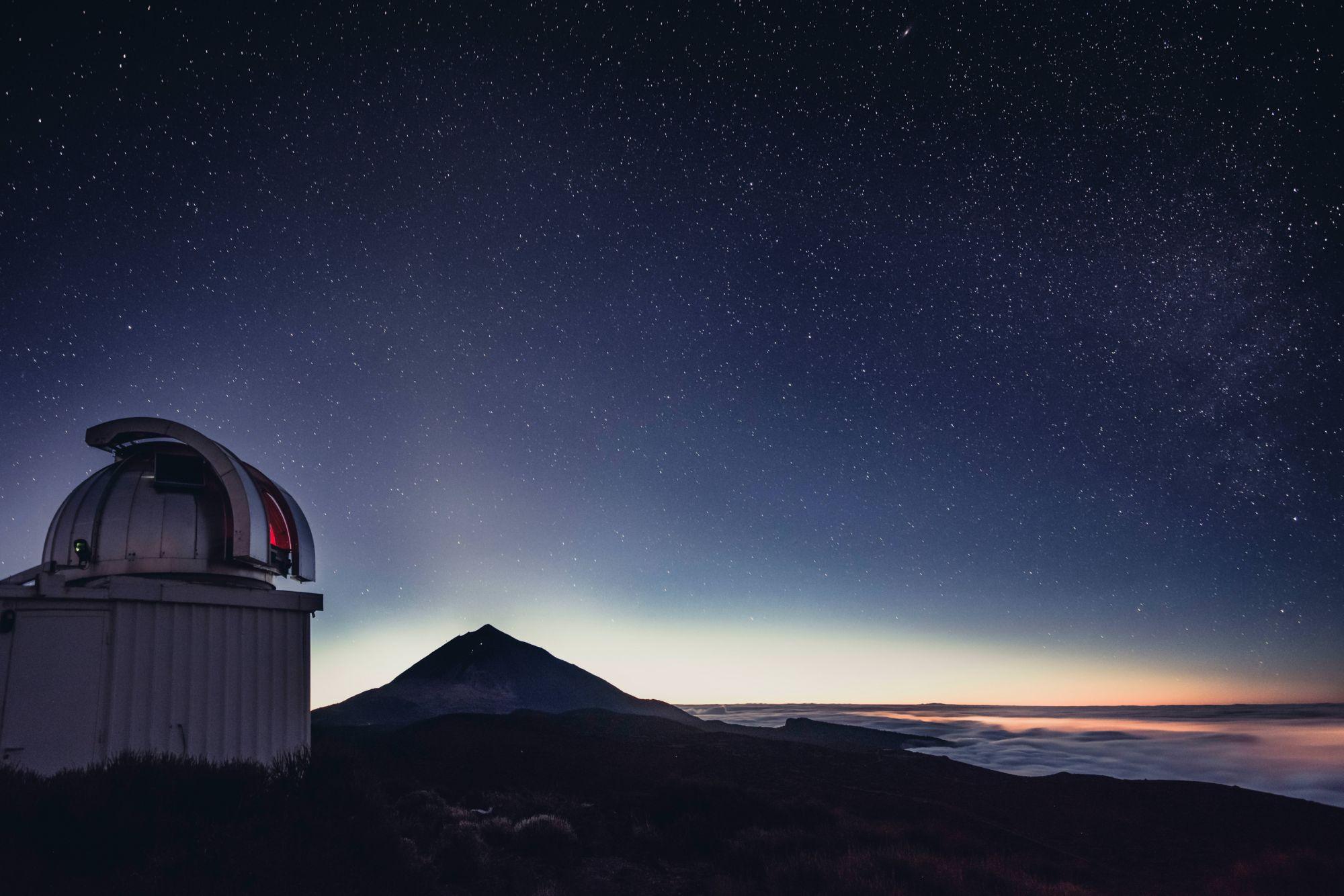
The quality of the starry skies in the Canary Islands is certified by several international bodies. ©Westend61 GmbH/Alamy Stock Photo
Poetry of a starry sky. In the Canary Islands this is a dirge that can be discovered night after night, without rhetoric. Because with three 'Starlight Reserve' destinations, a label that guarantees and certifies the cleanliness of the skies, the Canary Islands are truly the perfect destination for those who love to lose themselves in the wonder of a mantle full of celestial bodies. Earning this accolade are La Palma, Tenerife and Fuerteventura, but these are not the only destinations to be marked on this map that hunts for the best places in Europe and the world to observe stars, planets and constellations.
Everything, in the observation points scattered among the islands of the archipelago, contributes to the experience: first of all, the Trade Winds, winds that push the clouds further away, leaving the sky clear. And then the thermal inversion, which, once again, keeps astronomers' number one enemy at bay. Clear skies, low pollution and projects related to observing and promoting astro-tourism, such as the EU Sky Route carried out in Tenerife, encourage more and more people to venture to the most beautiful viewpoints, peek at the sky with the naked eye or strap on a telescope. Tenerife is home to the world's largest telescope, and it even has a name: his name is Gregor and he is able to push the eye out into the universe, where man has always tried to reach in some way to grasp its mysteries. The Teide National Park, located on one of the Canaries' best-loved and most popular islands, is really the beating heart of the archipelago's (astro)tourist plan. But it is not the only one: between Gran Canaria and El Hierro there are several spots where the experience of touching the sky with a finger becomes reality, without any artifice. For the most enthusiasts, the work of theCanary Institute of Astrophysics offers guided tours and exciting adventures in the vault of heaven in the two most interesting observatories: the Teide Observatory in Izaña (Tenerife), and the Roque de los Muchachos Observatory in Garafía, on the island of La Palma. Constellations, planets, astronomical phenomena: there is just about everything, above the Canarian ocean.
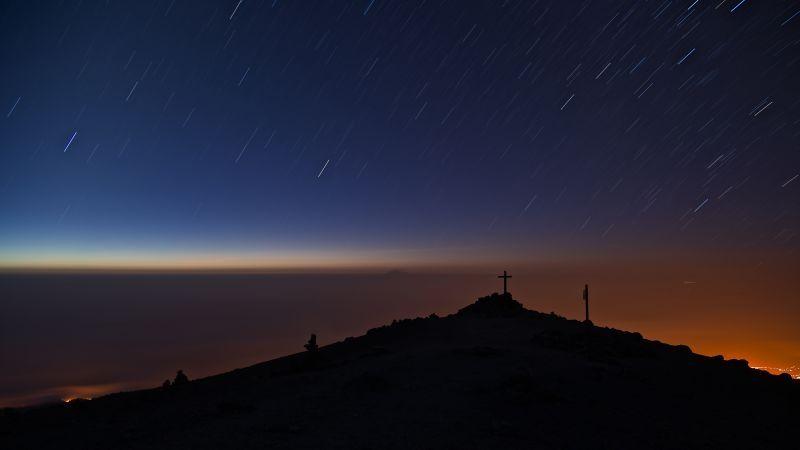
A clear night of stars and peace in the Canaries. ©Juliane Keil/Lonely Planet
Teide National Park, emblem of astrotourism
The Teide Park is a favourite destination for those who 'want to go out and see the stars again' in a natural setting that cannot be found elsewhere. Tenerife has earned the Starlight Tenerife certification precisely because of the infinite possibilities - as infinite as the sky is - of its peaks and observation points in the Park. The mountain of Guajara is perhaps the most popular: you reach a peak of more than two thousand seven hundred metres (2,718, to be precise) after a walk that is not easy: it is better to start equipped and trained from the base. At the summit, however, waiting for the explorers, there they are: Cassiopeia, the North Star, Pegasus. Just raise your nose upwards to see them, proud and eternal, in their celestial positions.
For less experienced hikers, the Park outlines its route with a myriad of observation points and belvederes. The richest is undoubtedly that of Masca, on the north-western side of Tenerife. Alone in the presence of the firmament, more than a thousand metres above sea level and with no artificial lights around, you will discover what the universe is capable of. And, especially between September and October, you will learn to recognise the constellations of the autumn zodiac: Pisces, Aquarius, Capricorn await in the south-eastern sky. The luckiest and most observant will also see Fomalhaut, the absolute star of the Southern Pisces constellation.
The Palm and the inalienable right to contemplate the sky
The island's chosen site is undoubtedly the Roque de Los Muchachos Observatory, more than 2,400 metres above sea level. And perhaps La Palma, with its incredible atmospheric conditions that keep the skies clear, is one of the most emblematic destinations on this map exploring the firmament above the Canaries. It was here (and as proof that you are serious about the stars) that the World Declaration in Defence of the Night Sky and the Right to Observe the Stars (also called the La Palma Starlight Declaration) was signed in 2007. The romantic stance - grant us this - of this edict affirms the unquestionable and inalienable right to "an uncontaminated night sky" to enjoy the contemplation of the celestial mantle, "comparable to the rest of the environmental, social and cultural rights [...]".
However, the Observatory of the Roque de Los Muchachos is not the only spot on the island where one can lift one's gaze. There is the beautiful natural terrace of San Borondón, the Volcano of San Antonio and the Llano del Jable viewpoint, in the upper part of El Paso, that make La Palma a chosen place for astronomical tourism.
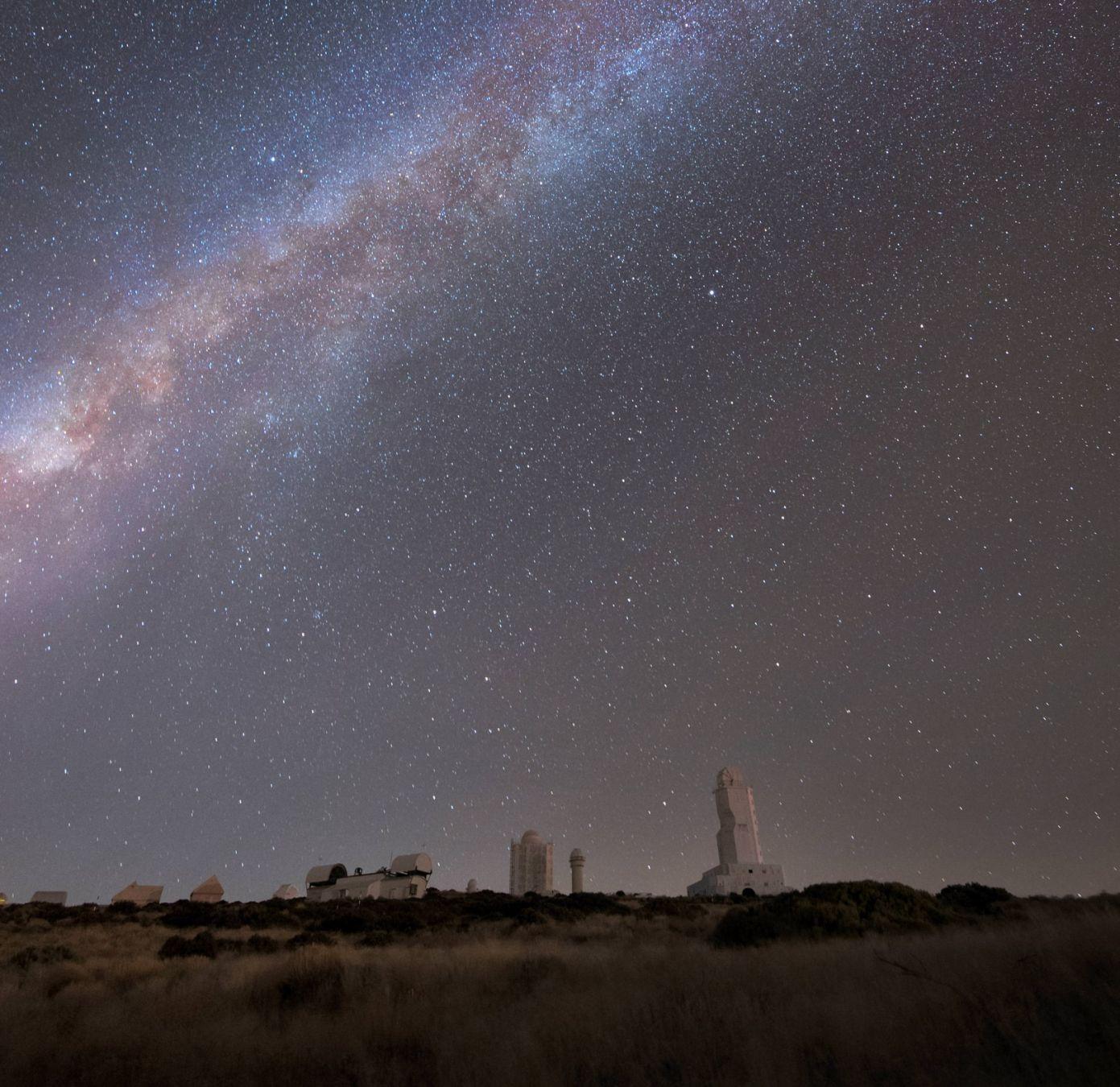
View of the Canary Islands sky on a night with perfect visibility. ©Westend61 GmbH Alamy Stock Photo
The sky above Fuerteventura
From the natural terrace of Morro Velosa one looks towards the north-west to observe Cassiopeia, especially on late summer evenings. But there are also Ursa Minor, the North Star and the band of stars of the Milky Way shining not far away. The best place to visit on the island is undoubtedly the observatory of Tefía, near which you can also stay overnight to enjoy the spectacle of Sirius shining in the firmament in comfort.
In Gran Canaria on the Llanos de Garañón
Hunt for constellations from a privileged vantage point: the one located 1,700 metres above sea level on the island of Gran Canaria, in Llanos de Garañón. Here the sky is a true spectacle: in spring the stars of the northern hemisphere shine, that winter hexagon formed by 7 moving stars with emblematic names: Castor and Pollux, Capella, Aldebaran, Rigel, Sirius and Procyon. They are part of the constellations of Gemini, Auriga, Taurus, Orion, Cane Major and Cane Minor.
Sign up for our newsletter! For you weekly travel tips, special offers, stories from the world and 30% discount on your first order.